Understanding the chakras is a doorway into understanding yourself.
This is the first in a series exploring the seven major chakras, offering a grounded introduction to yogic energy anatomy and how it relates to your physical, emotional, and energetic experience.
Before we begin, I invite you to stay open. This is a subtle subject that sits between science and spirituality. While modern science continues to explore the nervous system and bioenergy, ancient yogic traditions have long mapped the inner landscape of human consciousness.
Both perspectives can complement each other.
What does “chakra” mean?
The Sanskrit word chakra means “wheel” or “circle”, but in yogic understanding it is more accurately described as a vortex or energy centre.
There are many chakras in the body, but the main system consists of seven major chakras, aligned along the spine.
They are traditionally represented as lotus flowers, symbolising spiritual unfolding from:
- ignorance
- to awakening
- to illumination
The energy body in yoga
Yogic philosophy describes the human being as made of five layers of existence:
- Physical body (Annamaya Kosha)
- Mental body (Manomaya Kosha)
- Energy body (Pranamaya Kosha)
- Wisdom body (Vijnanamaya Kosha)
- Bliss body (Anandamaya Kosha)
The chakras belong to the energy body, which is said to contain thousands of subtle energy channels.
Among these, three are considered most important:
- Ida (feminine / lunar energy)
- Pingala (masculine / solar energy)
- Sushumna (central spinal channel)
These channels intersect along the spine, forming energetic junctions. These intersections correspond to the seven main chakras.
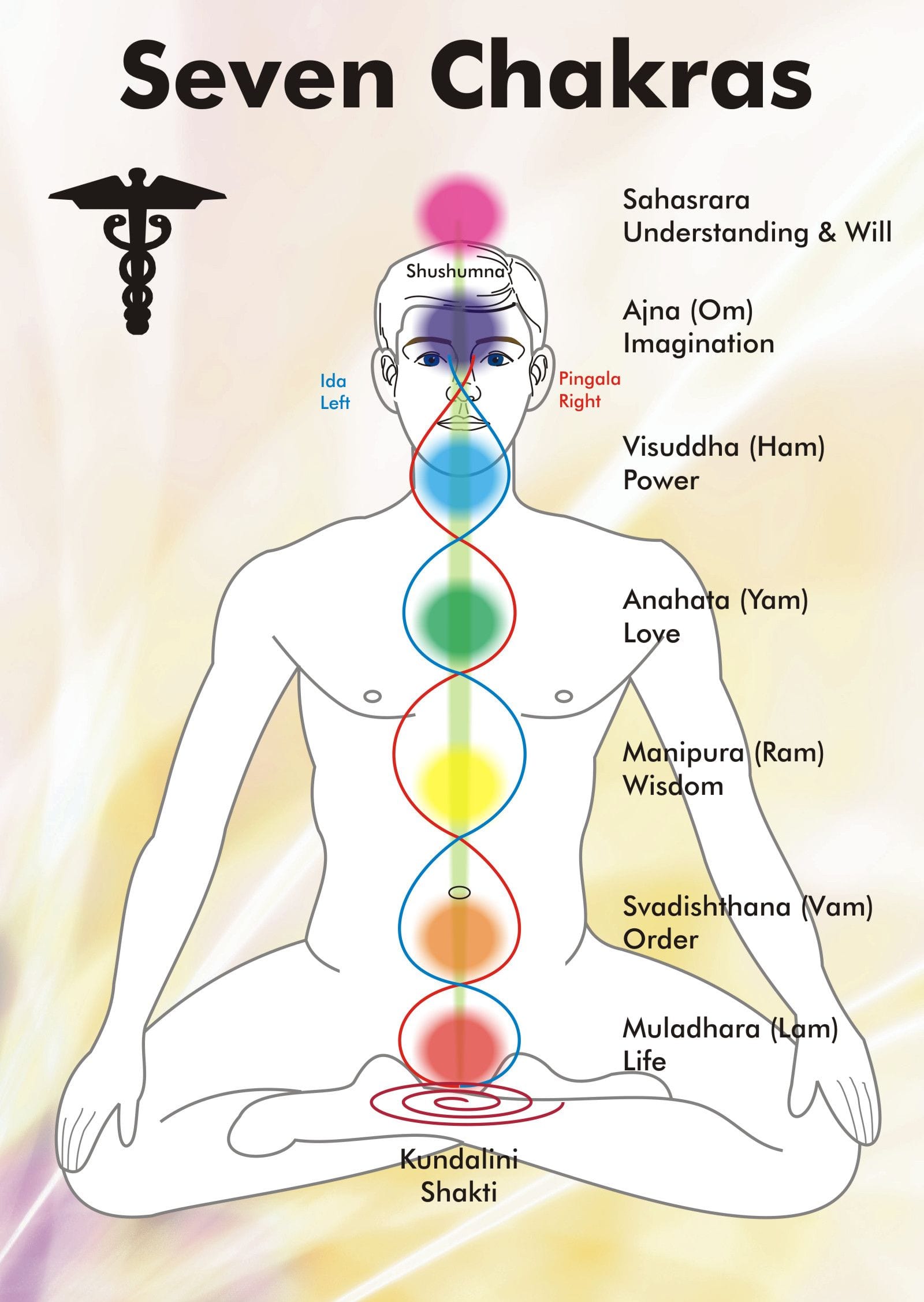
Ida, Pingla, Shushumna, Kundalini Shakti and the seven chakras
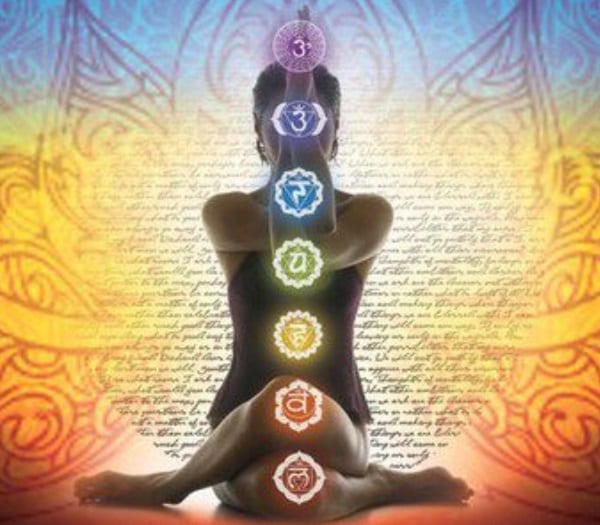
The seven chakras
From base to crown:
- Root Chakra (Muladhara)
- Sacral Chakra (Swadhisthana)
- Solar Plexus Chakra (Manipura)
- Heart Chakra (Anahata)
- Throat Chakra (Vishuddha)
- Third Eye Chakra (Ajna)
- Crown Chakra (Sahasrara)
Each chakra is associated with:
- an element
- a colour
- a psychological theme
- physical organs and nerve centres
- energetic and emotional patterns
The seven chakras
From base to crown:
- Root Chakra (Muladhara)
- Sacral Chakra (Swadhisthana)
- Solar Plexus Chakra (Manipura)
- Heart Chakra (Anahata)
- Throat Chakra (Vishuddha)
- Third Eye Chakra (Ajna)
- Crown Chakra (Sahasrara)
Each chakra is associated with:
- an element
- a colour
- a psychological theme
- physical organs and nerve centres
- energetic and emotional patterns
How do chakras affect us?
Each chakra influences how we experience life.
For example, the Root Chakra relates to safety, survival, and grounding. When balanced, we feel stable and secure. When imbalanced, we may experience anxiety or disconnection from the body.
In the same way, each chakra reflects different aspects of:
- emotional regulation
- personality patterns
- physical health
- energetic flow
This is why no two people experience life in exactly the same way. Our energetic system influences perception.
When the chakras are balanced
When energy flows freely through all chakras, the system becomes more integrated and aligned.
In yogic philosophy, this allows energy (prana) to flow through Sushumna, activating higher states of awareness and deeper clarity of consciousness.
This process is sometimes referred to as Kundalini awakening, though for most people the focus is simply:
- balance
- wellbeing
- emotional clarity
- physical vitality
A practical perspective
You do not need to approach the chakras as something mystical or distant.
At a simple level, this system can help you:
- understand emotional patterns
- recognise stress in the body
- support healing and self-awareness
- reconnect body, mind, and breath